
Behind 53 Ivy‑League Offers and 524 Top‑30 Admissions: What Elite US High‑School Placement Reveals About the Underlying Mechanics of Undergraduate Admissions
US‑College Applications Are Not a 12th‑Grade Endeavor — It Is a Long‑Run Strategic Game Starting in 9th Grade
As the new school year kicks off, one of our students at American Heritage Schools (AHS) has officially entered 12th grade.

Working with numerous families pursuing overseas education each year, we repeatedly observe the same pattern: even among students attending reputable overseas high schools, some glide smoothly through application season with steady momentum and clear goals. Others find themselves overwhelmed, rushing to take extra tutoring, cobbling together extracurricular activities at the last minute, and revising essays right up to deadlines.
What creates this divide?
It is rarely raw talent. What truly separates outcomes is whether students grasp one fundamental truth from the outset: US‑college applications are not something you start in 12th grade; they represent a long‑term strategic game that begins in 9th grade.
Drawing on AHS’s recent admissions results and an admissions‑officer workshop they hosted, we unpack this question: what mechanisms allow elite US high‑schools to set their students up for seamless application‑season success? The answer lies neither in inflated acceptance statistics nor cosmetic application polishing. It hinges on a developmental framework that helps students understand admissions criteria well in advance.
Admissions Results Reflect Systems, Not Luck
Consider the hard data for AHS’s Class of 2026 graduates:
Ivy League institutions: 53 offers of admission
US Top‑30 national universities: 524 graduates earned acceptances
University of Florida (Top‑5 public university nationwide): 217 students admitted
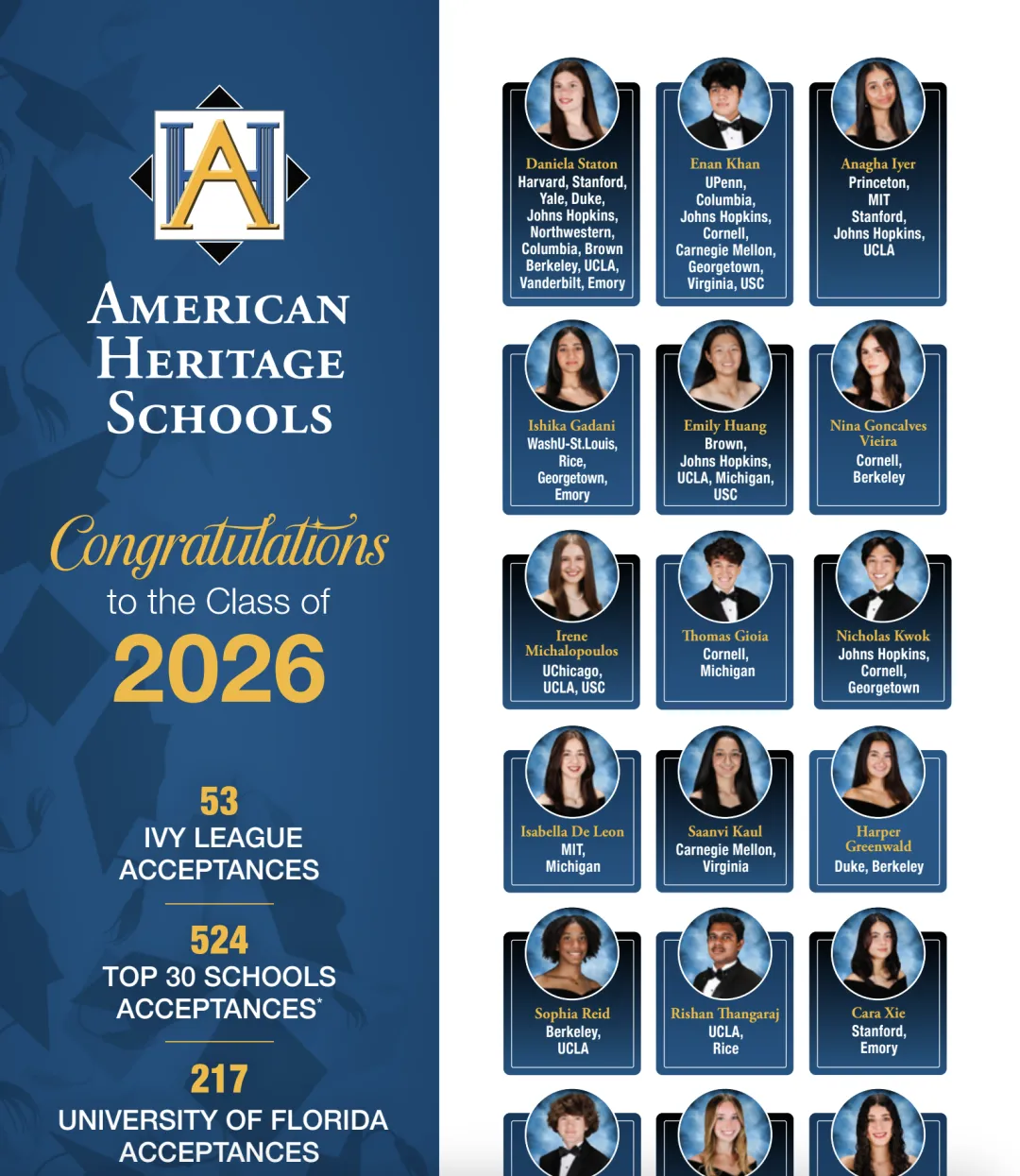
According to official 2026 college‑matriculation data released by AHS, these 524 Top‑30 acceptances are not victories secured by a small handful of star students; they represent broad‑based success across a large cohort.
Admission to Ivy‑League schools for isolated individuals can be attributed to talent or chance. Broad‑ranging outcomes for 524 students cannot be explained away by luck. They signal that the school systematically teaches large groups of students how admissions actually work, rather than only cultivating a small pool of standout pupils.
Yet most parents read these statistics and simply think “this school is outstanding”, without digging deeper. Impressive numbers deliver little actionable insight unless you understand how the school achieves such results.
AHS does one thing many other schools overlook: it breaks down admissions‑officer evaluation logic and shares it with students long before application season.
Instead of only inviting admissions officers to give talks when applications open, the school places students in the role of an admissions‑committee member starting in earlier grades. Students review simulated applicant files firsthand, learning what evaluators look for, how they assess candidates, and the reasoning behind their decisions.
This is the core value of AHS’s admissions‑officer workshop. Its merit is not merely bringing in guest officers — many schools do that. The real value comes from letting students reverse roles: rather than passively listening to rules, they act as reviewers and judge sample applications using those very criteria.
Once you have personally rejected an applicant with a perfect GPA yet underwhelming recommendation letters, your understanding of how to plan your high‑school trajectory changes entirely.
Four Core Truths from the Workshop: Not Hacks, But a Timeline
Within the workshop, admissions officers walked through real‑case examples to lay out four realities of US‑college admissions. These ideas are not new; parents familiar with US applications may have encountered them before. Most households, however, treat them as last‑minute application tricks. At AHS, students use these principles to guide their choices from age 14 onward.
The same rules amount to cramming if you learn them in 12th grade; they become long‑term strategic planning when you master them at 14.
Below we restructure these four truths chronologically. They are not independent tips for avoiding mistakes, but a decision‑making chain spanning Grades 9 through 12.

Grade 9: Academic Rigor Counts More Than a Perfect GPA
One classic workshop exercise asked the mock admissions committee to vote between two hypothetical applicants:
Candidate A took eight AP courses with a 3.85 GPA.Candidate B enrolled only in standard‑level classes and earned a perfect 4.0 GPA.
Who would receive the offer? To many parents’ surprise, officers favored Candidate A.
Elite universities are fully aware of how demanding each high‑school’s curriculum is. Earning top grades exclusively in basic courses strikes reviewers not as excellence, but as reluctance to step outside one’s comfort zone. Students willing to take on rigorous coursework and maintain solid performance demonstrate they can thrive amid the heavy academic load at top‑tier universities.
What matters is not your absolute GPA number, but your willingness to pursue more challenging pathways.
Course‑selection strategy must be mapped out starting in Grade 9. Admissions officers look for an upward trend: building momentum in Grade 9, increasing course difficulty in Grade 10, and tackling the most demanding offerings in Grade 11. This trajectory must be set from the very first year of high school.
Grade 10: Reject “Shallow Versatility”, Build a Core Narrative
A second revealing comparison emerged in the workshop.
One student logged 50 volunteer hours, joined multiple clubs, and dabbled in a wide array of activities — the archetypal “well‑rounded” applicant. A second student concentrated on a single field for two consecutive years and even secured a patent.
Admissions officers were unambiguous: elite universities aim to assemble a well‑rounded class composed of specialized standout talents, not well‑rounded individual applicants who spread themselves thin across many pursuits. Fifty hours of disjointed checkbox‑style participation carries far less weight than sustained deep engagement solving real‑world problems within one domain.
10th grade is the critical window for defining your core focus. Take stock of your three most time‑invested pursuits. Ask yourself: can these threads weave together into a cohesive personal profile? If not, it is time to cut back. Concentrating energy to excel in one area and take leadership roles yields far greater impact than superficial involvement across five or six activities.
A common misstep among families we counsel is overloading students in Grades 9‑10 with clubs, competitions, volunteer work and research projects. By Grade 11, students realize nothing ties together, and every effort remains superficial — with too little time left to refocus.
Grade 11: College Essays Are Not Creative Writing Assignments; They Require Cultivating Your Authentic Voice
Many families believe essay writing only begins during application season. This is incorrect.
Essays are the only component of an application package that lets a human personality emerge behind test scores and grades. Admissions officers read dozens of essays daily and can instantly spot formulaic template pieces: narratives about dramatic competition comebacks, or moving epiphanies from volunteer trips abroad. By contrast, an essay with genuine personal voice and thoughtful self‑reflection will hold reviewers’ attention, even with minor gaps in standardized metrics.
Workshop officers demonstrated this contrast side‑by‑side: template‑style essays are skimmed and discarded within seconds, while authentic reflective pieces are read fully. The divide lies not in polished prose quality, but in genuine reflective thinking.
This “voice” cannot be crammed during summer break before Grade 12. It accumulates gradually through academic inquiry, classroom debate, and in‑depth exchanges with teachers starting early in high‑school. Students who have long practiced questioning ideas and discussing academic nuance in class draw upon abundant real‑life material when they sit down to write in Grade 11. Those who avoid critical reflection and attempt to manufacture stories at application time produce work readily identified by admissions teams.
Grade 12: Recommendation Letters and Early‑Decision Strategy — Success Built Long Before Senior Year
The final truth concerns recommendation letters and school‑selection strategy. One workshop case described a student with flawless GPA and test‑score metrics whose recommendation hinted the candidate “complies with instructions yet lacks initiative”. This file was quickly rejected.
Generic praise in recommendation letters is fatal. Reviewers want concrete anecdotes illustrating intellectual curiosity and drive. A single specific line such as “One observation this student shared in class left a lasting impression on me” carries ten times more weight than generic comments about good character and academic performance.
Strong recommendations are not requested in 12th grade; they are earned from Grade 9 onward. Meaningful intellectual rapport between students and teachers develops over years, and cannot be conjured with a last‑minute email.
The same principle applies to application strategy. Early Decision (ED), a binding early‑application round, typically yields acceptance rates two to three times higher than Regular Decision (RD). This is the biggest leverage point in US‑college admissions. Yet students only get one ED opportunity. You should reserve ED 1 for your true top‑choice dream school, and pre‑build your tiered list of reach, match and safety schools starting in Grade 11.
By Grade 12, room for major adjustments shrinks. Standardized tests are complete, extracurricular profiles are fixed, and there is insufficient time for deep essay refinement. ED planning is not a last‑minute senior‑year call; it requires scenario‑building beginning in 11th grade.
Revisiting the Core Question: What Does a US High‑School Actually Change?
A great high‑school does not hand out acceptance letters. It delivers an environment where students understand admissions criteria early and make informed choices. AHS’s 53 Ivy‑League offers and 524 Top‑30 acceptances are not “gifted” to students by the school. Starting in Grade 9, the institution helps students see exactly what admissions officers measure, then provides resources and time for students to meet those benchmarks.
Polishing applications is done in senior year. Institutional frameworks operate from day‑one of high‑school enrollment.
US‑college admissions is a long‑distance race. Quality American high‑schools offer a far more efficient starting line. If you are considering the US‑high‑school pathway, or your child already attends one, fixating solely on acceptance‑rate rankings is secondary. What truly matters is verifying whether the school has that framework to help students decode admissions rules ahead of time.
Where such systems exist, application‑season success comes naturally.
Where you draw your starting line determines how far you can go.


